B-17 Bomber Flying Fortress – The Queen Of The Skies The history of the B-17

 English
 Deutsch
“Without the B-17, we might have lost the war.”
General Carl Spaatz
The B-17 Flying Fortress remains a legend in the history of the Second World War. It was the bomber that struck deep into occupied Europe, in daylight, taking on the might of the Luftwaffe, braving the ferocious German flak defenses. It was the bomber that could hit precision targets from five miles up then return home, sometimes with massive structural damage. It was the bomber that held ten flyboys, many still teenagers, and bound them into a though fighting unit.
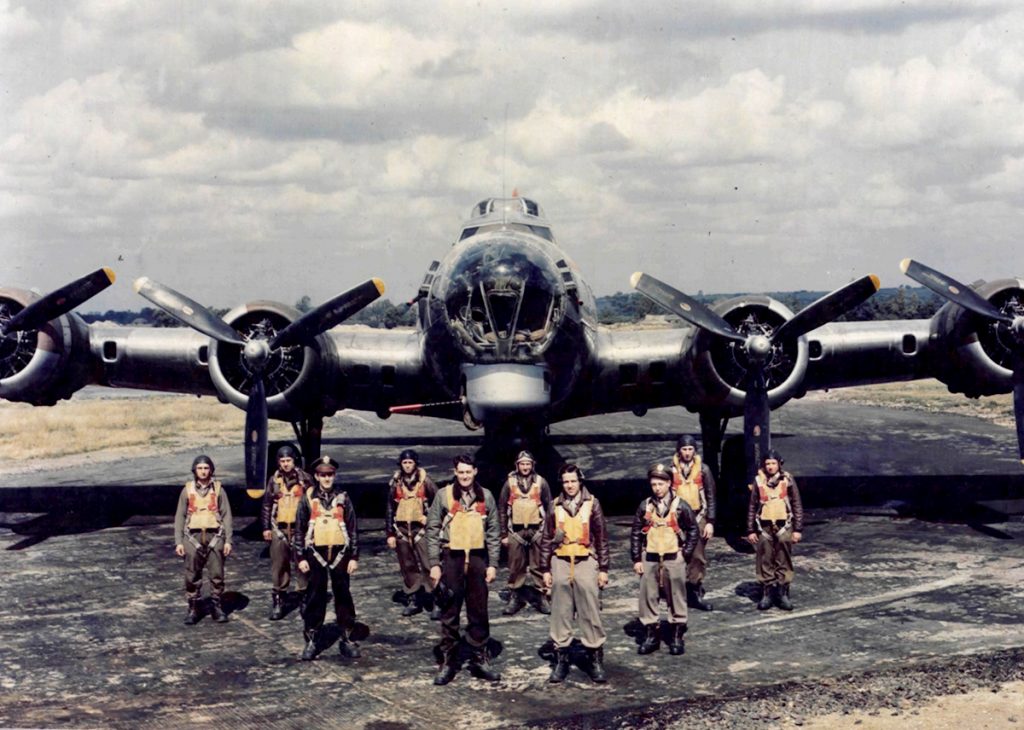
“Had to be taken off in a B-17 like with a Greyhound bus or a fully loaded truck, you had your bombs, your fuel and your ammunition. You have very wound the thing and tried to keep it there. The cockpit was the worst place to see something up there since you could see only straight ahead and this was it. You could not look around or look to below. You have more information of the navigator or bombardier got who sat in the plexiglass nose.
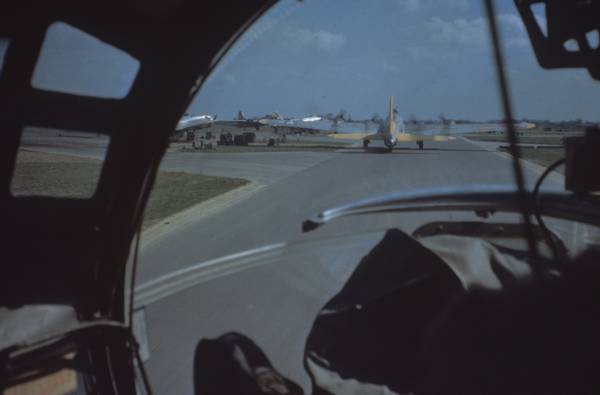
I have always felt sorry for the navigator or the bombarider. In the cockpit we had armor platings under the seat and in the back and a little to the sides but everything what had this one around himself, was plexiglass. They were there where they could be met by the bullets. Both engines of a wing had failed far home away over France once. We had to take her propellers to feathered position so that the propellers didn’t rotate like windmill vanes and made the flat sheets to us more slowly. We took the gas of the two remaining engines back. With two dead engines on a side flying gets exhausting since the weight of the bleak side the B-17 moved down. We were busy high and the aircraft to think busy, this wing at flying so that we didn’t think at all that it could fall away. You have watched all engines, checked the oleograph all the time, the turns per minute, particularly when you were met by anti-aircraft gun. The B-17 was easy to fly. I have flown a B-24 for a couple of hours and it was right work. You really thought the B-17 had stably and simply to be flown “the thing flies himself'”
USAAF Pilot Officer Robert Davila
The development
![B-17Es at Boeing Plant // Wikipedia Commons [Public Domain]](https://b17flyingfortress.de/cms/wp-content/uploads/2015/12/B-17Es_at_Boeing_Plant_Seattle_Washington_1943-600x433.jpg)
Commissioned by the US Army Air Force, her specifications were those of a “battleship of the skies”; a multi-engined bomber capable of 200 to 250 mph at 10,000 feet with a cruising speed of 170 to 200 mph, a range of 6 to 10 hours and a service ceiling of 25,000 feed. Some designers of the Boeing Airplane Company proved something like vision by not deciding as usual in favor of two but in favor of four jet engines. Even if they wanted to reach more height thus primarily over the aim area they also caused so anyway that Boeing Model 299 turned fundamentally bigger than the outlines of the competition this out. The work on the drawing-board started on June 18th, 1934.
When newspaper reporters were first shown the Model 299 in Boeing’s Seattle factory on 16th July 1935, the aircraft simply took their breath away.
“Why, it’s a flying fortress!”
Richard Williams, reporter for the Seattle Times, upon seeing a B-17
“A regular fortress”, one of them said, “a fortress with wings!”
The Boeing Airplane Company lieked the name used in the headlines, so decided to register it as a trade mark. “The Flying Fortress” was born.
The first flight
Les Tower led the prototype to Boeing Field for a successful first flight on July 28th, 1935. Main purpose of the new bomber was the defense of the United States an invasion fleet through. When the thirteen pre-mass-production aircrafts in the US Army air corps arrived got her the model number YB-17. Y stood for the evaluation, B for bomber and 17 for the seventeenth bomber design, that the USAAC had accepted. It was a fighter plane which surpassed all demanded features for speed, range, path speed and bomb load.
“Hitler built a fortress around Europe. He forgot to put a roof on it!”
Franklin Delano Roosevelt
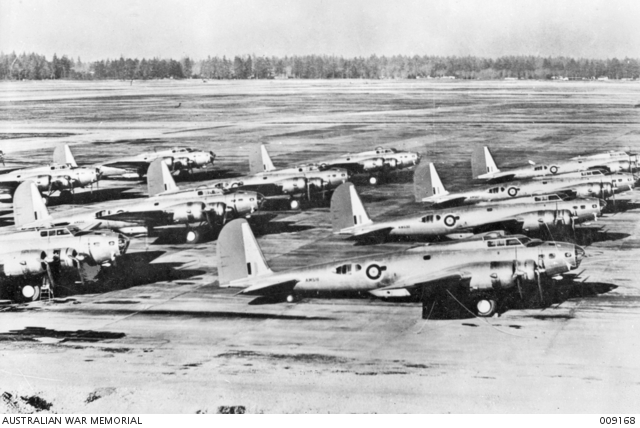
President Roosevelt’s realization that involvement in a war in Europe could not be avoided, combined with the bombers good press, ensured that it was not long before the first orders were placed with Boeing for the production of the turbo-equipped B-17B’s. Luckily, the B-17 had one more feature: its adaptability to further development. Thirty-nine B-17Bs were delivered to USAAC when the war broke out in Europe 1939, followed by thirty-eight B-17Cs and forty-two B-17Ds; new improved designs that could give 323 mph top speed at 25,000 feet. In 1941, the RAF were sent twenty B-17Cs and Bomber Command designated Them Foortress Is.
Combat
Boeing eventually took note of any design faults in the erly types and produced, what was in effect, a completely new bomber, the B-17E, with its distinctive large tail fin and much improved firepower. The company built 512 B-17E’s and then progressed to the B-17F which was the first truly battle-ready Flying Fortress. The B-17F rolled off the production line in the summer of 1942 and Boeing were eventually to built 2,405 of them. The B-17F was to be the model that flew the US 8th Air Force daylight unescorted raids into Europe in 1943.
The next model, the B-17 G was the final development of the design. 8,680 B-17G’s were built. In total, Boeing managed to equip 108 squadrons of the 8th Air Force, 20 squadrons of the 15th Air Force in Italy and provided 200 B-17’s to be used by the RAF. Most of the men who had flown a B-17 knew, that it was a rigged plane.
It was calculated that the average life of a B-17 flown by the US 8th Air Force was 215 days: for 119 days the aircraft was non-operational, it was under repair for 49 days and flying missions for 47 days.
Such was the fury of aerial combat in the European theater of operations that it was notable if a B-17 survided 25 missions in its first year.
The first crew, who finished 25 combat missions in Europe was the crew of the “Memphis Belle”
The following table shows the outputs of the B 17 of the respective for manufacturer.
| Model | First Flight | Boeing | Douglas | Vega | TOTAL |
| 299 | 28 .Jul 1935 | 1 | 0 | 0 | 1 |
| Y1B-17 | 02. Dec 1936 | 13 | 0 | 0 | 13 |
| Y1B-17A | 29. Apr 1938 | 1 | 0 | 0 | 1 |
| B-17B | 27. Jun 1939 | 39 | 0 | 0 | 39 |
| B-17C | 21. Jul 1940 | 38 | 0 | 0 | 38 |
| B-17D | 03. Feb 1941 | 42 | 0 | 0 | 42 |
| B-17E | 05. Sep 1941 | 512 | 0 | 0 | 512 |
| B-17F | 30. May 1942 | 2300 | 605 | 500 | 3405 |
| B-17G | 21. May 1943 | 4035 | 2395 | 2250 | 8680 |
| Sum | 6981 | 3000 | 2750 | 12731 | |
| Proportional | 54.8% | 23.6% | 21.6% | 100% |
Post War
After the Second World War, many B-17 were taken off from their employment federations and by replaced their large big sister, the B-29 Superfortress. Most were sent back into the states and landed at the scrap iron place. But only few remained in the U. S. Air Force, where further use for them was. In addition, abroad the B-17 prospective customer found.
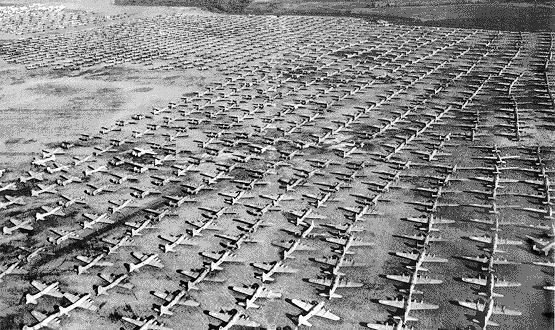
After the war was over in Europe, were of 31 Bomber Groups 2118 B-17s flown to the USA and put down by Arizona in a desert between 19th May 1945 to 9th June 1945, many were scrapped and only some were bought by private people or organizations. Whether B 17 stand today certainly there isn’t known to me.
Few B-17 converted the U. S. Air Force and during the Korea war as transport aircraft for its struggle-high officers (VB-17G) and distress rescue airplanes (SB-17G/B-17H) and used these during the Korea war 1951-1953. These machines started usually from the airfields in Japan. In addition used in the 50’s superseded B-17 to atomic test purposes around to test like airplanes to an atomic pressure wave to react (see photo, MATS = US air transport command)
During the Second World War many B-17 landed more or less intact in the neutral countries such as Sweden. These used some B-17 during and after the war as transport aircrafts.
1948 succeeded to come it Israel into the possession of 3 B-17G. Two machines did not have cannons, which were tower holes openly or provisionally taken off, the navigation equipment was missing and nevertheless Cairo on the flight became to Israel bombarded. No machine was lost. But they all were unfortunately scrapped into the 50s.
| USAAF S/N | Civil-Registration |
| 44-83753 | N5024N |
| 44-83811 | N5014N |
| 44-83842 | N7712M, interned in Portugal |
| 44-83851 | N1098M |
Between 1951 and 1955 Brazil arrived into the possession of 13 B-17. 5 was SB-17G and 6 RB-17G. They were assigned to the Forca Aerea Brasilia (FAB). All this B-17 was used for search and rescue missions or for photographic clearing-up. These machines were deactivated in late 60’s.
| FAB S/N | USAAF S/N | Comment |
| 5400 | 44-83663 | 1968 Returned to the US.Displayed in Air Force Base Hill |
| 5401 | 44-85567 | Retired from service in 1967 |
| 5402 | 44-85583 | Retired from service in 1968 |
| 5403 | 44-85602 | Retired from service in 1966 |
| 5404 | 44-85836 | Crash 1959 |
| 5405 | 43-39246 | Crash 1962 |
| 5406 | 43-39335 | Retired from service in 1966 |
| 5407 | 44-8891 | Retired from service in 1967 |
| 5408 | 44-83718 | Retired from service in 1968. Restored in a brasil air force museum. |
| 5409 | 44-83764 | Crash 1964 |
| 5410 | 44-83378 | Retired from service in 1965 |
| 5411 | 44-85494 | Retired from service in 1968 |
| – | 44-85579 | Crash 1952 |
In February 1947 two B-17 arrived into the possession of the Dominican Republic. They survived until 1954.
Between 1947 and 1960 five SB-17G were with the Portuguese in the employment.
US general Eisenhower handed over to France the B-17F 42-30177 special transport for the French general M.P. Koenning. It was scrapped 1973.
Into the 60ern few B-17 were converted to fire-extinguishing airplanes, in order to fight forest fires.
Even if the B-17 could modify still so well and be used for tests, the B-17 was seen also gladly in the film world.
Beside several war documentations 1949 appeared the feature “Twelve O’Clock High” with the B-17 and with the famous actor Gregory Peck.
Beside smaller roles in “Tora! Tora! Tora!” and “1941, where please Hollywood” is got the B-17 1969 a larger role into the film “1000 of planes Raid”.
But the most beautiful photographs of the B-17 knows one in its youngest and most well-known film “Memphis Belle” to see.